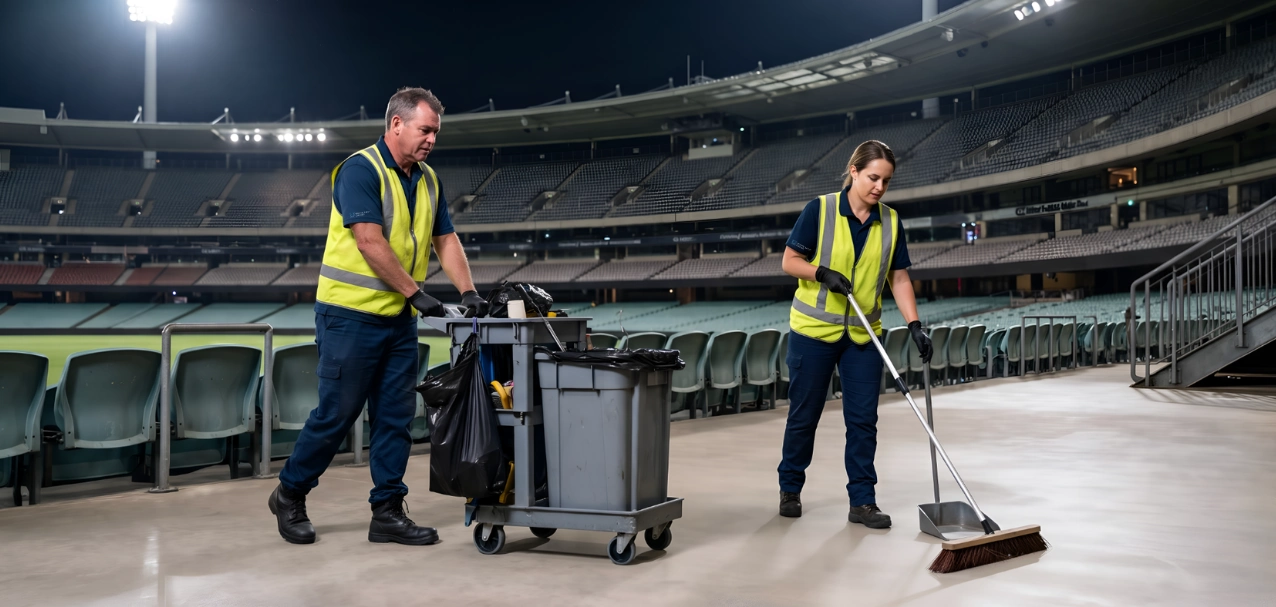
Stadium cleaning services live or die on timing. When you have 40,000 people leaving, broadcasters packing up, security closing sections and a 120-minute changeover clock ticking, you do not get a second chance. WHS rules do not relax because the fixture went to extra time, and neither do your service level expectations from hirers, sponsors and fans.
In this playbook we walk through how we treat a stadium as a controlled operation. We cover how to grid the venue, structure surge staffing, run in-event cleaning, hit aggressive turnaround windows and move waste in line with truck schedules and council rules, all while staying aligned with ISO 9001, ISO 14001 and ISO 45001 systems and documented WHS obligations.
Turning a Stadium Clean in Hours Not Days
Stadium cleaning services are very different to a standard commercial office or school contract. Crowd behaviour drives heavy food and beverage load, sticky concourses, spills in aisles, glass risks, sharps and high-wear amenities that go from clean to distressed in minutes. On top of that, you have short bump-out and bump-in windows, broadcast visibility requirements and strict WHS controls defined in venue risk registers and SWMS.
On event day, facility managers really have three levers they can pull with any confidence:
• Surge staffing numbers and mix
• Precision scheduling across clearly defined zones
• Waste logistics that match truck access, local council rules and precinct curfews
If those three elements are not planned together, you end up with missed bays, safety incidents, contamination in bins and friction with hirers. In practice that shows up as unserviced rows on broadcast camera, near misses logged in WHS systems and rejection of contaminated recycling by haulers.
Mapping the Stadium as an Operational Grid
The first step is turning the venue into an operational map. We break the site down into clear areas such as the bowl, concourses, corporate suites, food courts, amenities blocks, player and broadcast zones, car parks and the external public domain. Each area has different risk profiles, foot traffic and cleaning methods.
We then define:
• Clean zones, dirty zones and transition points
• Plant and machinery routes that match WHS traffic management plans
• Controlled access points that align with venue security overlays
Those controls sit inside zone-based scopes of work and SWMS. For example, slip-prone concourses get specific detail on spill response, floor chemistry and dwell times for degreasers. Amenities have high-risk hygiene requirements, with documented frequencies, ATP testing where used and clear outbreak protocols. Corporate and hospitality areas need pre-event presentation cleaning and quick turnarounds between functions, with standards tied to contract KPIs and inspection checklists. Broadcast, media and VIP spaces often require both stricter cleanliness standards and tighter confidentiality, which shapes staffing, access lists and sign-on procedures.
Building Event-Day Surge Staffing Without Losing Control
To get through an event safely and cleanly, we treat staffing as a layered model. Most large venues have:
• A permanent core crew that knows the site and systems
• Casual event crews who boost numbers to match attendance and fixture profile
• Specialist teams for height work, confined spaces or hazardous waste
Everyone needs site-specific induction, role-based training and competency checks linked to SWMS and WHS procedures. When peak season hits, such as winter football codes with short turnarounds, rostering must respect fatigue management, night penalties, split shift limits and award conditions documented in HR and WHS systems. It is not just about coverage, it is about safe coverage.
Briefing and debriefing are where we keep control. Toolbox talks are tied to that event’s risks, for example, wet weather concourse slips or late-night finishes, and are recorded in pre-start templates. Supervisors use radios for live direction and escalate issues into a CAFM or quality system. For an ISO 9001- and ISO 45001-aligned provider, that real-time logging supports incident investigation, trend analysis and documented corrective actions.
Stadium Cleaning Services During Live Events
During the event, cleaning is as structured as any other part of the show. We usually set up:
• Roving concourse teams focused on bins, spills and food waste
• Amenities attendants for constant touchpoint cleaning and consumables
• Spill response crews targeting high-traffic aisles, ramps and bars
• Food court teams aligned to service peaks, not just clock times
Incident response protocols must be tight and known. Bodily fluids need defined chemicals, PPE and disposal methods aligned to infection control procedures, manufacturer SDS and WHS Regulations. Sharps and broken glass go through specific container and reporting paths, with incident numbers raised in the WHS system. Security-related contamination is handled in line with venue emergency plans and often requires joint response with security and venue management.
Cleaners need to stay visible without becoming a hazard. That means hi-vis clothing, agreed parking spots for bins and gear, and equipment positioning that does not obstruct egress routes in the Emergency Control Organisation plan. Coordination with ushers, security and food and beverage operators helps move around queues and prevent bottlenecks.
Hitting Turnaround Windows and Managing Waste
The real pressure often comes the moment the final siren sounds or the last encore finishes. We time the sequence from the first patrons exiting to hand-back and build that into run sheets and SLAs. Crews are staged ahead of time at known hotspots such as bar zones, main amenities, vomit-prone areas and primary exits so they can start as soon as sections clear.
We run:
• Production-style run sheets by zone and time band
• Dedicated radio channels per stand or level
• Colour-coded area completion boards or digital dashboards
This reduces double-handling and missed rows. Quality sign-off involves visual standards for the bowl and corporate areas, checks on hazards such as residual spills, and where reasonable, slip checks documented on the hand-back form. Photographic evidence linked to audit systems can be invaluable when hirers or broadcasters question standards after a tight turnaround.
Waste is its own operation. Typical stadium profiles include co-mingled recyclables, organics from kitchens, general waste, cardboard, sharps and event-specific streams like promotional items or pyrotechnic residuals. Waste plans must match:
• Local council and private hauler schedules
• Compactor capacity and safe operation windows
• Cage rotations, bin staging and loading dock traffic plans
If loads are rushed without sorting, contamination rises and recycling targets are lost, which shows up clearly in monthly hauler reports. When data from waste streams is captured properly, venue owners and sponsors can see diversion outcomes for bottles, cans and organics at major fixtures. That information supports ESG reporting and can also be referenced in sponsorship recaps and precinct sustainability reporting.
Winter Pressures and Turning Fixtures Into Controlled Operations
Winter codes bring compressed calendars, broadcast-driven rescheduling and back-to-back events across AFL, NRL and other codes. Wet conditions increase slip risk, slow crowd exit and stretch cleaning windows. We plan for extra matting, boosted concourse patrols and alternative drying methods when external areas need to be safe for early morning commuter traffic.
At turf level, cleaning and grounds must work as one. Chemical selection, water use and machinery routes all need to respect pitch protection requirements as well as WHS controls. That includes agreeing no-go zones, wheel types, water run-off controls and timing for any work near the playing surface.
For facility managers, the next step is to translate this playbook into contracts. That means clear service levels for pre-event, in-event and post-event scopes, defined KPIs, WHS and quality reporting expectations and planned waste outcomes. After two or three major fixtures, a structured review of incident trends, waste diversion and non-conformances can reset the plan and tighten controls.
At White Spot Group, stadium cleaning sits alongside security, catering and turf as a core event function, not a back-of-house afterthought. We run venues across Australia and New Zealand to documented standards, and every fixture gives us data to adjust resourcing, SWMS and waste plans so the next event is safer, cleaner and more controlled than the last.
Lock In Event-Day Cleaning That Matches Your Stadium’s Risk Profile
If you are working to tighten turnaround windows, reduce post-event waste backlogs and keep WHS audits clean, we can map a stadium-specific program around your event calendar. Our stadium cleaning services combine surge staffing, SWMS-backed task lists and ISO-audited QA so your operations team is not firefighting after every fixture. We draw on our experience across Australian and New Zealand venues to plan crowd flows, bin placement, high-pressure cleaning and waste contractor timing in one integrated run sheet. Share your next event schedule with White Spot Group via contact us and we will scope a practical, site-tested cleaning model your FM team can rely on.