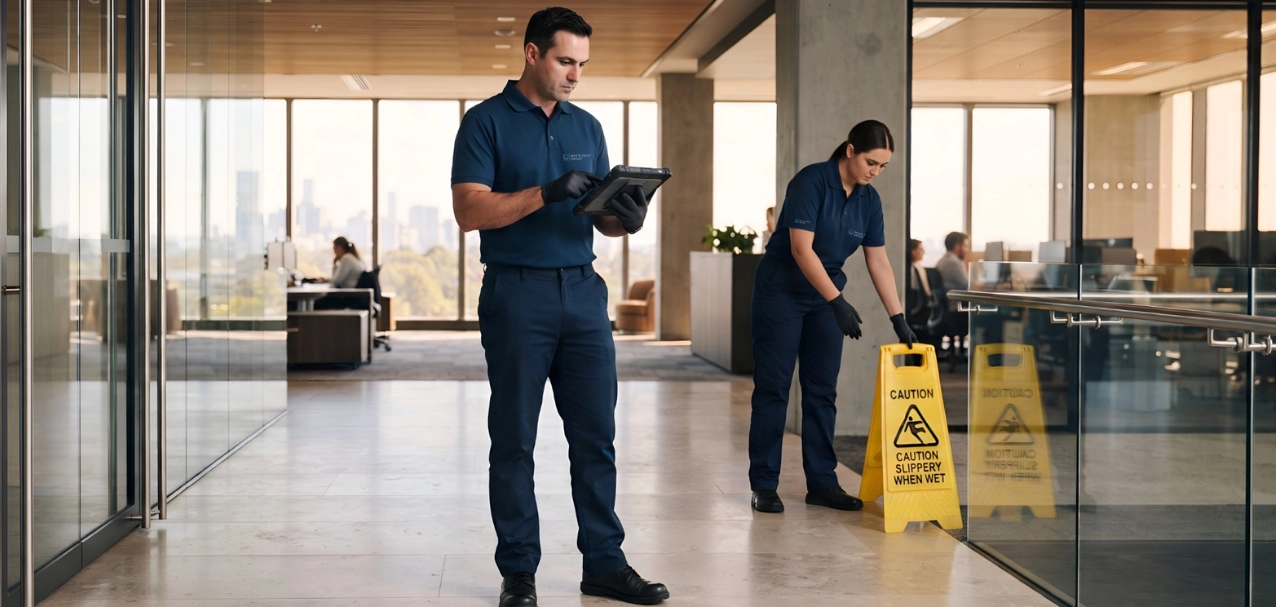
Slip, trip and fall incidents are no longer just a quick mop and a courtesy call to the client. Once a person is hurt and a claim is on the table, your response as a cleaning contractor becomes a WHS, insurance and governance issue. The first hour after an incident often decides whether things stay contained or turn into a long dispute that drags in lawyers, regulators and insurers.
This is where a cleaning contractor with reporting systems that actually work makes a measurable difference. When your team can lock in CCTV, logs, witness notes and chemical records quickly, you support the PCBU’s duties, protect the brand on site and give everyone a clearer view of what really happened.
When a Slip Becomes a Claim, Not Just a Mop Job
Think of a wet winter day, external walkways soaked, foyer mats saturated, and foot traffic streaming in for a conference or clinic. A visitor goes down near the entry and within hours the client is chasing CCTV, inspection logs, and proof that signage was in place. If your team is scrambling for paperwork or guessing who was on site, you are on the back foot from the start.
For healthcare, education, government and large corporate portfolios, incident response is now a compliance issue, not just customer service. Claims link straight into WHS duties, insurance conditions and sector frameworks like the NQF and ACECQA for early learning sites.
A cleaning contractor that runs ISO-aligned systems for quality and safety can help the PCBU show due diligence in a way that stands up to external review. That comes from having clear processes to preserve evidence, structured reporting, and traceable records, not from a one-page incident form that sits in a folder.
Building an Incident Response Playbook That Actually Works
An incident response playbook only works if it is simple enough to follow when people are under pressure. Every site should have a clear trigger point, for example any slip, trip or fall, whether injury is obvious or not.
Key elements of a workable playbook include:
• Role allocation for cleaners, supervisors, security and facilities teams
• A short escalation tree with phone numbers and after-hours contacts
• Agreed communication rules between contractor, FM team and centre management
• Pre-set templates for incident reports and photographs
Site-specific SWMS, risk registers and method statements need to line up with this response. For example, high-risk areas like entrance lobbies, supermarket fronts and hospital corridors should have tested procedures for wet weather, spills and crowding.
These procedures should be drilled at least quarterly, not just left in an induction pack. Toolbox talks and refresher sessions should reference real incidents from the site and portfolio, not generic scenarios.
There is a clear operational benefit when you engage a cleaning contractor with reporting systems that integrate with the client’s CMMS or workplace app. When inspections, incident reports and corrective actions are logged in the same ecosystem, you reduce double handling and capture timestamps, GPS and user IDs automatically.
Securing CCTV, Access Logs and Digital Trails Before They Vanish
CCTV footage can determine the outcome of a slip claim, but only if it is preserved quickly and correctly. The first task is to know who controls each camera system on the site, whether that is the client, centre management, a third-party security firm or a combination.
Practical steps for CCTV preservation include:
• Request footage within hours, not days
• Specify the exact time window, cameras and entry points
• Confirm how long footage is kept, often only a few weeks
• Ask for export in a format that includes time and date stamps
Access control logs, contractor sign-in systems and BMS records can support the sequence of events. They show who was on site, when inspections were done and whether risk controls like wet floor signs or barriers were in place.
A contractor with ISO-aligned reporting systems will also standardise how files are named, stored and accessed. That means:
• Unique incident IDs used across footage, photos and reports
• Secure folders with controlled permissions and audit trails
• Clear rules about who can release files to insurers and legal teams
This structure helps keep evidence admissible, traceable and safe from accidental deletion or overwriting.
Getting Witness Statements and Staff Notes That Hold Up
Not all notes are equal. We look at three types in a slip, trip or fall investigation: contemporaneous notes, formal incident reports and structured witness statements.
Each has a role and timing matters. Delays increase the risk of missing details and inconsistent accounts.
A simple approach for supervisors is:
• Within 30 minutes, ask staff to write their own notes in their own words
• Focus on facts, not opinions, for example "floor was wet near mat edge," rather than "client never maintains mats properly"
• Use templates that prompt for location, weather, lighting, surface condition, footwear, signage and traffic levels
Witnesses from other contractors, tenants or the public can add useful detail. Usually, contact details should be requested via centre management or the client representative, not by cleaners directly approaching upset patrons.
Avoid leading questions like "You slipped on our wet floor, did you?" and stick with open prompts such as "Can you describe what you saw". Structured, timely notes help investigators in insurance, WHS and legal teams see what actually occurred, instead of relying on memory months later.
Chemical Records, SDS and Cleaning Logs Under the Microscope
Once a claim is raised, attention turns quickly to what was used on the floor, how it was used and by whom. The typical documents requested include:
• Safety Data Sheets for chemicals used in the area
• Dilution charts and on-site labelling
• Training records for the staff member on the task
• Equipment maintenance logs for auto scrubbers, polishers and vacuums
• Task schedules or sign-off sheets showing when the area was last cleaned
In high-risk zones like healthcare, food courts and education sites, safe chemical handling and documentation also need to align with Australian WHS Regulations, Poisons Schedules and sector requirements like the NQF and ACECQA. That covers storage, decanting, PPE and supervision.
Disciplined record-keeping strongly supports defensibility. For example, a machine scrubber service log can show that brakes and squeegees were checked and working.
A floor sealer specification can be matched to the slip rating in the building’s design documents. These details show that the PCBU and contractor took reasonably practicable steps, even if an incident still occurred.
Turning a Near Miss Into a Better System, Not Just a File Note
The value is not only in defending a single claim. Every incident or near miss is a stress test of your cleaning, WHS and governance systems.
Closing the loop properly matters if you want fewer incidents next season. Treating each case as a system check is more effective than treating it as paperwork.
A practical closeout process includes:
• An incident review with FM, the contractor supervisor and, if needed, safety representatives
• Root cause analysis, such as using an ICAM-style approach to look beyond human error
• Corrective actions built into SWMS, toolbox talks, refresher training and contract KPIs
• Seasonal reviews of entrance matting, inspection frequencies and hazard reporting
Across Australia and New Zealand, winter often brings more slips from wet entries, darker afternoons and heavier event traffic. Updating plans for those months should be informed by real incident data, not guesswork.
Facility managers should treat every slip or near miss as a live test of whether their cleaning contractor with robust reporting systems can protect both people and reputation. That means checking how fast CCTV is secured, how complete the notes are, how clean the audit trail looks and whether those learnings actually change the way the site is run next time it rains.
White Spot Group structures its cleaning, hygiene, grounds and support services around these incident management disciplines. The focus is on evidence, WHS alignment and defensible processes, rather than relying on good fortune when incidents occur.
Protect Your Organisation With A Cleaning Partner That Can Stand Up In Court
If a slip, trip or chemical incident ends up in a notice or a claim, you need records, not guesses. As a cleaning company with reporting systems, White Spot Group documents CCTV requests, incident logs, chemical data and witness statements so your WHS file is complete and defensible. We build reporting around your existing risk registers, NQF or ISO frameworks so your cleaning data lines up with how you already manage compliance. If you would like to review your current incident response and documentation processes, please contact us and we can walk through what good looks like for your portfolio.