How do you turn NQF childcare cleaning non-conformances into a 30-day win?
Good cleaning control can be the difference between a smooth ACECQA assessment and a painful re-rating process. When cleaning is not where it should be, the impact shows up quickly in Quality Area 2 and Quality Area 3, and it raises questions about WHS and infection control across the whole service.
In this article, we walk through how to turn cleaning non-conformances into a structured 30-day corrective action plan that holds up in audit. The focus is on practical actions for centre managers, nominated supervisors, approved providers, and facility teams that need clear evidence, not guesswork or last-minute fixes.
What triggers cleaning non-conformances in childcare audits?
Cleaning non-conformances in commercial early childhood services usually cluster around the same themes. Typical findings include:
• No clear cleaning schedule for rooms, bathrooms, and outdoor yards in long day care and kindergartens
• Inconsistent bathroom and nappy change cleaning between groups and shifts
• Poor infection control routines around high-touch points and body-fluid incidents
• Cleaning chemicals stored in open or child-accessible areas in operational zones
These issues link directly to NQS elements such as 2.1.2 and 2.1.3 for health and hygiene, and 3.1.2 and 3.2.3 for the suitability and maintenance of premises and equipment. Public health guidance on sanitation in education and care settings also expects clear, repeatable cleaning processes that can be demonstrated in practice.
On-site, authorised officers and auditors confirm compliance by:
• Walking the facility and visually checking cleanliness and chemical storage
• Reviewing cleaning schedules, sign-off sheets, SDS, and SWMS
• Asking educators and cleaners to explain their cleaning routines and what they do for spills, outbreaks, and nappy changes
When staff give different answers, or paperwork does not match what is happening on the floor, non-conformances usually follow. In multi-room commercial centres, this misalignment often shows up fastest in bathrooms, food prep areas, and sleep rooms.
How do you diagnose gaps in NQF childcare cleaning systems?
Before you fix, you need a clear picture of your current controls. A simple gap analysis starts with:
• The current cleaning scope of works for each room and zone, including outdoor play
• SDS and SWMS for all cleaning chemicals and tasks
• Site plans with risk areas marked, such as nappy change, food prep, and sleep rooms
Map these against NQS requirements, your service approval conditions, and national public health guidance on infection prevention in education and care. Confirm that your frequencies and methods match product contact times and manufacturer instructions, especially for disinfectants used in bathrooms, nappy change areas, and kitchenettes.
Evidence gathering is just as important as the written plan. Many commercial providers find value in:
• ATP or hygiene swabs in kitchens, bathrooms, and nappy change areas
• Sampling log books and sign-off sheets to check for gaps or patterns
• Photographs of high-touch points like door handles, cot rails, and toys
• Contractor performance reviews with documented follow-up on any issues
This level of detail makes it easier to show an authorised officer that you understand the problem and have treated the root causes. It also helps facility managers compare performance across multiple sites in a portfolio.
How do you build a 30-day corrective action plan that stands up in audit?
A 30-day corrective action plan works best when broken into clear phases. In commercial childcare portfolios, that structure gives boards and owners visibility on progress.
Days 1 to 3 focus on immediate risk controls:
• Fix obvious issues such as dirty bathrooms, unsafe chemical storage, or missed bins
• Introduce temporary checks, for example, extra bathroom inspections each hour
• Communicate short-term controls to all staff on-site and log them in the corrective action register
Days 4 to 14 focus on process and training changes:
• Redraft cleaning schedules by room, risk area, and frequency
• Update SWMS where tasks or chemicals have changed
• Deliver toolbox talks or short training sessions to cleaners and educators
Days 15 to 30 focus on verification and documentation:
• Spot-check practice against the new schedules and SWMS
• Close out non-conformances in your corrective action and improvement register
• File evidence such as updated documents, photos, and training records
Each corrective action record should include the issue statement, root cause, corrective action, preventive action, responsible person, due date, and verification method. Build these requirements into daily and weekly checklists, so an auditor can trace a line from the standard to the checklist to the condition of the room on the day.
How do you align childcare cleaning with WHS, infection control, and ISO?
Cleaning in early childhood facilities is part of your WHS risk control framework, not a separate function. Start with a WHS risk assessment that covers contamination risks, slips and trips, chemical exposure, and manual handling, then apply the hierarchy of controls.
In multi-site commercial services, ISO-style systems help keep cleaning controls consistent. Quality systems such as ISO 9001 guide you to standardise cleaning procedures, environmental systems like ISO 14001 support chemical and waste management, and safety systems like ISO 45001 help manage worker health and safety across all centres.
Infection prevention standards should sit inside your cleaning specifications, not beside them. That should include:
• Clear hand hygiene expectations for staff and cleaners
• Appropriate disinfectant selection for different zones
• Contact times written into procedures, not left to chance
• Outbreak escalation plans with defined trigger points and cleaning responses
When these controls are documented and actually used, you reduce both infection risk and compliance risk. You also create a clearer line of sight between WHS obligations, NQF expectations, and day-to-day practice.
How should you handle training, supervision, and contractor control?
Every commercial childcare site needs a clear training matrix for anyone who cleans on-site, whether in-house or contract. At a minimum, this should cover:
• Infection control basics in an early childhood setting
• Safe chemical handling, SDS, and PPE use
• SWMS for regular and non-routine cleaning tasks
• Response steps for body-fluid and other high-risk incidents
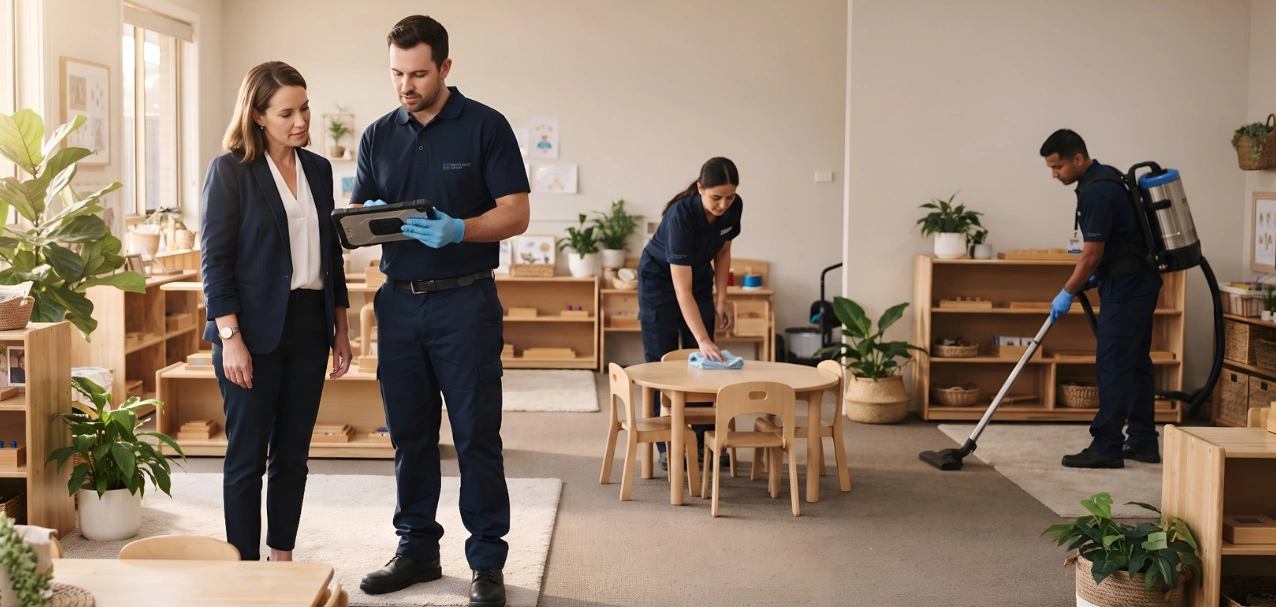
Supervision of contract cleaners should be structured and documented. Many services use:
• Scheduled inspections with simple scoring and comments
• Photographic evidence for both good performance and issues
• Spot checks during operating hours to see real conditions
• Monthly performance reviews linked to documented KPIs
Cleaning contracts should spell out NQF-related expectations with defined service levels, non-conformance thresholds, and rectification timeframes. That allows facility managers to escalate performance issues before they become ACECQA findings.
How do you prove your corrective actions to ACECQA and regulators?
Authorised officers want to see that problems are fixed and that improvements will last. An evidence package for cleaning should usually include:
• Updated cleaning schedules and scopes of work
• Staff and contractor training records and attendance sheets
• Daily and weekly checklists with signatures and dates
• Incident reports and close-out notes for cleaning-related events
• Before-and-after photos for key risk areas
When you present your 30-day corrective plan, keep it simple and factual. Show the original finding, your root cause analysis, the actions taken, the dates, and how you will monitor performance.
Useful supporting documents include:
• Sign-off sheets for bathrooms, nappy change, and food prep areas
• Risk register entries that link cleaning risks to controls
• Corrective action close-out reports that summarise outcomes
Treat this as part of a continuous improvement cycle, not just a one-off response. Many commercial services now schedule internal pre-assessment audits at least quarterly and use independent commercial cleaning providers with NQF, ACECQA, and WHS experience to pressure-test their systems.
At White Spot Group, our facility teams have managed commercial childcare portfolios across Australia and New Zealand for years and have seen how a clear 30-day corrective roadmap, backed by ISO-certified systems and practical WHS controls, can turn cleaning non-conformances into stronger and safer operations. When documentation, site practice, and training align, cleaning moves from a weak point in assessment to one of the easiest areas to demonstrate effective and sustained improvement.
Close NQF Cleaning Non‑Conformances Before Your Next Assessment
If you need NQF corrective actions closed within 30 days, we can help you tighten cleaning schedules, evidence and sign-off to ACECQA auditor standards. Our ISO systems, SWMS and site-specific checklists are built into our NQF-compliant childcare cleaning program, so you can prove control of hygiene risks, not just say it. At White Spot Group, we work directly with centre directors and approved providers to align cleaning outputs with your QIP and risk register. If you would like a site review and gap report, please contact us to book a visit.